Does YouTube penalise AI channels
- Published
- Last updated
- Written by
- launchtube
No penalty on generated content is visible in launchtube’s data. Across 63 channels matched by upload age on 16 September 2026, presenter-led and real-footage channels in the same niches declined as hard as the generated ones. Over a common window the generated channels fell 43 per cent at the median and the control fell 56 per cent, which makes this a null result at this sample size rather than proof that no penalty exists.
What the test compared
The question was put to an age-matched cohort test on 16 September 2026. Three groups were compared: 33 generated channels off the shortlist, 20 presenter-led or real-footage channels in the same niches, and the 10 shortlisted channels — 63 channels in all. The second group is the control. Its job is to price in the fact that cumulative views always decline on this measure, whoever made the video.
| Group | Channels | What it is for |
|---|---|---|
| Generated, off the shortlist | 33 | The population the question is about |
| Presenter-led or real footage | 20 | The control, in the same niches |
| Shortlisted model channels | 10 | Selected at their peak, so expected to fall |
Uploads are compared by how old they are, quarter by quarter, never by calendar date alone. That matters because views accumulate with a video’s age: every group falls on this measure, so only the comparison between groups is load-bearing and the absolute decline figures are overstated in all three. The page on how growth is measured sets out that bias and the other measures the sweep leaned on.
How far each group fell
Two passes were run over the same cohort. Over a common window from the first quarter of 2025, the generated channels fell 43 per cent at the median and the presenter-led and real-footage channels fell 56 per cent. The control fell harder than the group under suspicion, which is the finding. On a year-on-year, age-symmetric pass the two were within four points of each other: generated 39 per cent down, the control 35 per cent.
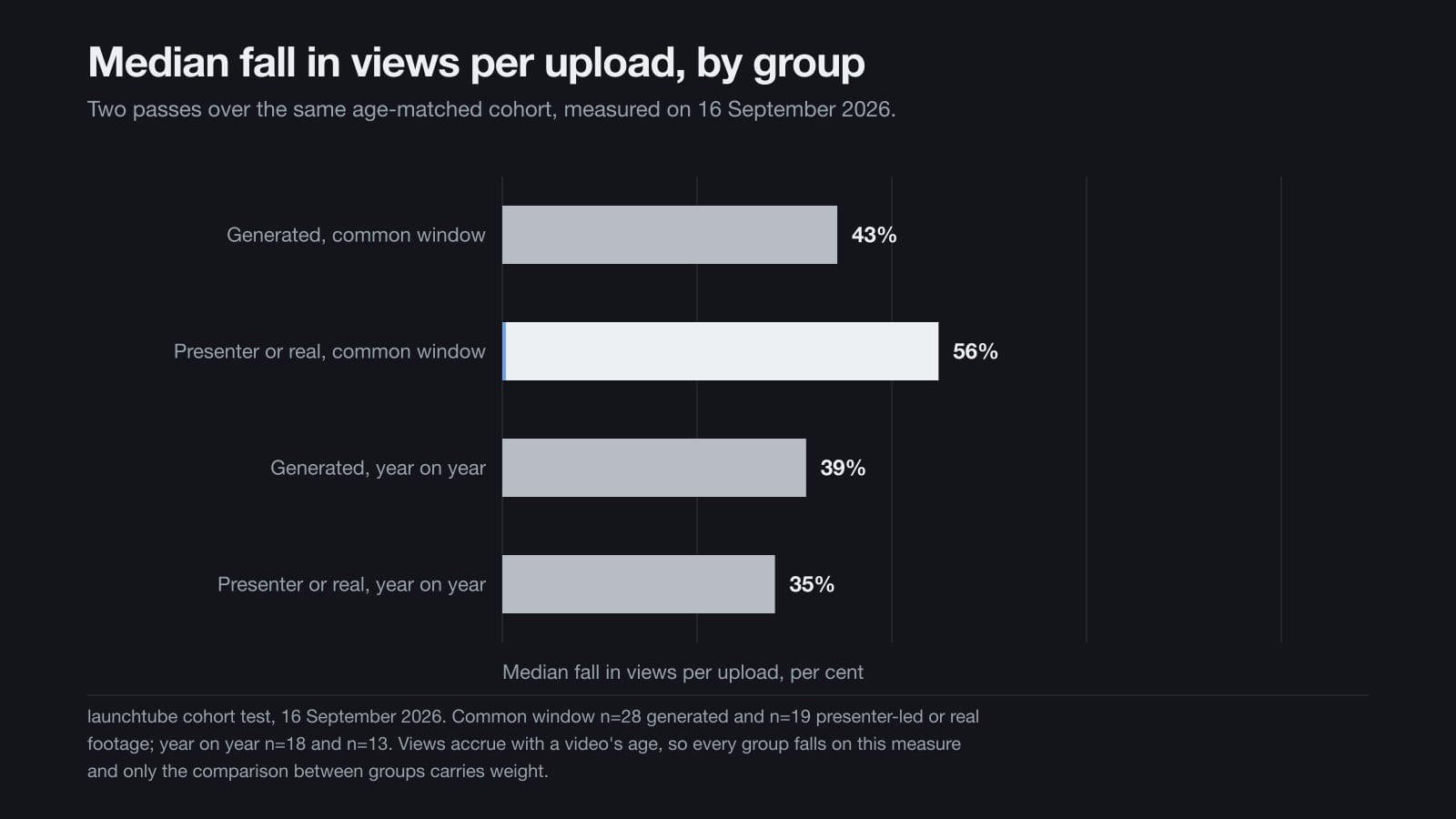
| Pass | Generated | Presenter-led or real footage | n |
|---|---|---|---|
| Common window, from Q1 2025 | down 43 per cent | down 56 per cent | 28 and 19 |
| Year on year, age-symmetric | down 39 per cent | down 35 per cent | 18 and 13 |
The two passes put the control on either side of the generated group. That is what no visible difference looks like in a sample this size, and it is a weaker statement than either pass would be on its own.
How many channels were down, and how many were at their best
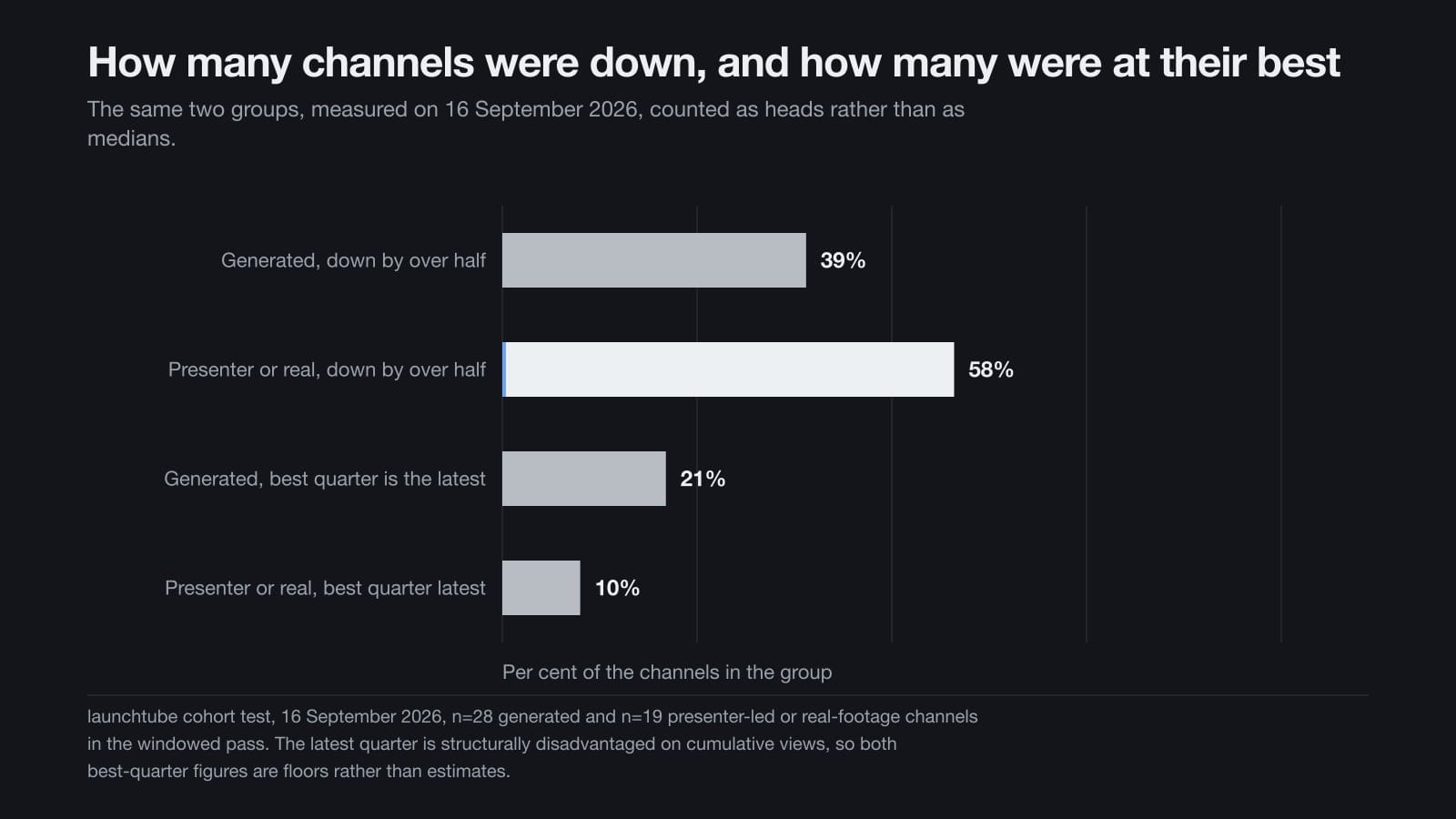
Counted as heads rather than as medians, the picture holds. The share of channels down by more than half was 39 per cent among the generated channels and 58 per cent among the presenter-led and real-footage ones. Twenty-one per cent of the generated channels and ten per cent of the control had their best quarter most recently. The latest quarter is structurally disadvantaged on cumulative views, so both of those last two figures are floors rather than estimates.
Whether there was a single moment when things changed
If a platform had acted against generated content on a date, the channels would share a peak quarter. They do not. Peaks were spread across six quarters in both groups, and the index declined smoothly rather than dropping at a single date. That rules out a single algorithm event inside this window. It cannot rule out gradual, channel-by-channel effects, which would look exactly like what is drawn here.
One apparent step does show up, and it is an artefact. A dip in the second quarter of 2026 appears in all three groups, including the real-footage channels, because the youngest uploads have had least time to accrue views. The most recent quarter in any chart of this kind is not comparable with the ones before it.
Why the shortlisted channels fell hardest
The shortlisted channels fell furthest of the three groups, at 79 per cent over the common window, on nine channels in the windowed pass. That is not evidence of a penalty. They were picked because they were at their peak, which guarantees a fall afterwards. The explanation the data supports is regression to the mean rather than a platform action. It is an interpretation, and the alternative — that those particular formats burned out — is not excluded by this test.
This is the reason the shortlist’s decline is kept out of the headline answer. The comparison that carries weight is generated against presenter-led and real footage, not the shortlist against itself. The findings page sets out what those eleven channels looked like on the way up.
The one generated channel that was accelerating
Twelve channels were sampled for a decay check and eleven were decaying. One was not: it roughly tripled its subscriber rate, from about 6,455 a month to about 23,310 a month, on nine archived snapshots read to 16 September 2026. One channel is not a trend, but it is enough to show the decline is not a property of generated content as such.
The wider count says the same thing more quietly. Among the generated channels that were never shortlisted, one in four was at its peak when it was measured — seven of twenty-eight. Peak quarter is measured on cumulative views, so the most recent quarter is disadvantaged, which if anything understates that number.
What YouTube itself publishes about disclosure
Separately from anything launchtube measured, YouTube publishes a rule on disclosure. Its help page on altered or synthetic content states that setting the disclosure label does not limit reach or monetisation. That is YouTube’s own published position as fetched on 15 September 2026, quoted as a help-page fact. It is not a measurement, it can change, and it says nothing about other policies that may apply to a given video.
The same page sets out when the label is required: the disclosure applies to content that shows a realistic scene, place or event, and clearly animated content is exempt from it. That is a summary of the published rule as recorded on that date. It is not legal or policy advice, and a publisher should read the current page rather than this one. Both facts come from YouTube Help answer 14328491.
YouTube also publishes YouTube channel monetization policies covering mass-produced and repetitious content. This research did not measure them and this page makes no claim about them; they are listed in the sources because a reader asking whether generated content is penalised will want the published rules alongside the measurements.
What this test cannot see
The limits are the reason the answer is stated as no visible penalty rather than as no penalty. The test uses cumulative views only, nine channels were excluded for having no mature long-form quarters, and nine catalogue fetches were capped at 300 uploads. It is an observational cohort on public view counts, not an experiment, and it can say nothing about individual policy actions against individual channels or videos.
There is also a class of channel the research never measured. Whole content classes were found to be dominated by real people, real crime or real victims, and were excluded on content grounds rather than performance grounds. Much of the measured growth in three of the twelve classes sat there. That is a statement about where the growth was, not a judgement about the channels publishing it, and the page on niches sets out which classes it applies to.
Nothing on this page states click-through, retention or revenue for any channel. None of those is public for a channel launchtube does not own, and the research deliberately never collected one. The rest of the research covers what could be measured instead.
How this was measured
Discovery ran on 15 September 2026: 36 search.list calls against the YouTube Data API, three content phrasings for each of twelve content classes. That returned 302 unique channels. A mechanical filter — 40 or more uploads, 5,000 or more subscribers, under 60 months old — left 35 candidates.
Each candidate was taken apart upload by upload. Uploads under 28 days old were excluded, because they have not finished collecting views. Shorts of three minutes or less were counted separately from long form. The outlier multiplier for an upload is its views divided by the median views of its neighbours in the same format bucket, which measures a video against its own channel rather than against YouTube. The trailing form, which divides by the previous ten uploads only, is the primary measure, because it divides by uploads that already existed when the video was published; the centred form, which divides by the ten before and the ten after, is a secondary reading and is biased against early uploads.
Three phrasings per class is thin. Two classes were re-swept with fresh phrasings and both changed their answer, so a class with no qualifying channel is under-sampled rather than empty. Subscriber counts are a single snapshot. Click-through, retention and revenue are not public for any channel launchtube does not own, so no figure on this page states them.
The penalty question was put to an age-matched cohort test on 16 September 2026. Three groups were compared: 33 generated channels off the shortlist, 20 presenter-led or real-footage channels in the same niches, and the 10 shortlisted channels, 63 in all. Uploads are compared by how old they are, quarter by quarter, never by calendar date alone.
Because views accumulate with a video’s age, every group declines on this measure. The presenter-led and real-footage group is the control that prices that bias in, which is why only the comparison between groups is load-bearing and the absolute decline figures are overstated in all three groups.
What this test does not show: it uses cumulative views only, nine channels were excluded for having no mature long-form quarters, and nine catalogue fetches were capped at 300 uploads. Group labels were inherited from the earlier sweeps and were not independently re-audited. It is an observational cohort on public view counts, not an experiment — a null result at this sample size rather than proof that no penalty exists, and it says nothing about individual policy actions against individual channels or videos.
Questions people ask
Does YouTube penalise AI-generated channels
No penalty is visible in this data. Presenter-led and real-footage channels in the same niches declined at least as hard as the generated ones across 63 age-matched channels measured on 16 September 2026. That is a null result at this sample size, not proof that no penalty exists, and it says nothing about individual policy actions.
Did the generated channels fall faster than the others
They fell less. Over a common window from the first quarter of 2025 the generated channels fell 43 per cent at the median and the presenter-led and real-footage channels fell 56 per cent. On a year-on-year, age-symmetric pass the two were within four points of each other, at 39 and 35 per cent.
Was there a single date when generated channels dropped
No. Peaks were spread across six quarters in both groups and the index declined smoothly rather than stepping down at one date. A dip in the second quarter of 2026 appears in all three groups, including the real-footage channels, so it is an artefact of the youngest uploads rather than a signal about generated content.
Does setting YouTube’s synthetic-content disclosure reduce a video’s reach
YouTube’s help page on altered or synthetic content states that setting the disclosure label does not limit reach or monetisation. That is YouTube’s own published position as fetched on 15 September 2026, quoted as a help-page fact rather than as advice. It is not a measurement, it can change, and it says nothing about other policies that may apply to a given video.
Which videos need the synthetic-content disclosure
The disclosure applies to content that shows a realistic scene, place or event; clearly animated content is exempt from the label. That is a summary of the published rule as recorded on 15 September 2026, not legal or policy advice, and a publisher should check the current page.
Could a penalty exist that this test would have missed
Yes. The test uses cumulative views only, nine channels were excluded for having no mature long-form quarters, and nine catalogue fetches were capped at 300 uploads. Group labels were inherited from the earlier sweeps and were not independently re-audited. It can rule out a single algorithm event in this window; it cannot rule out gradual, channel-by-channel effects.
Sources and further reading
What this page is built from
- cohort test — generated channels against presenter-led and real-footage channels, age-matched — 63 channels: 33 generated, 20 presenter-led or real footage, 10 shortlisted
- decay check on the one accelerating generated channel in the sample — 9 archived snapshots on one channel, 12 channels sampled
- 17a — selection report, the selection effect on the shortlist — measurement rules P18-P25
- 17 — proof channels plan, P5 disclosure and the YouTube help-page sources — two YouTube Help pages fetched on 15 September 2026
- 17a — proof-channel sweep read-out, including the classes excluded on content grounds — 302 channels discovered, 35 through the filter, 12 content classes
The authorities this page draws on
- Disclosing use of GenAI content — YouTube Help answer 14328491 YouTube Help
- YouTube channel monetization policies — YouTube Help answer 1311392 YouTube Help
- Wayback Machine — the archived channel pages the subscriber histories were read from Internet Archive
- Top ways to ensure your content performs well in Google’s AI experiences Google Search Central, last updated
About this research
launchtube runs and publishes this research itself. It is one company's measurements of public YouTube channels, taken on a stated date with a stated method, and it is written by launchtube rather than by any named individual. Where a number cannot be traced to a file it is removed, not softened, and where the data cannot answer a question the page says so.
Every research page, and what launchtube does with it.
Add launchtube as a preferred source in Google