How faceless YouTube channels grow, measured
- Published
- Last updated
- Written by
- launchtube
On 15 September 2026 launchtube swept 302 faceless YouTube channels and took 35 of them apart upload by upload. These six pages are what that read-out supports: the sample size, the date and the method against every figure, and a plain note wherever the data cannot answer the question.
-
What were the fastest-growing channels publishing?
What the sweep recorded about the upload mix, the cold start, the shape of a working catalogue and the decline that followed, on the faceless channels measured on 15 and 16 September 2026.
-
How do you measure growth on a channel you do not own?
How growth was measured from outside a channel: the outlier multiplier, the three normalisations and which is primary, age-matched cohorts, survivorship, and why the public replay curve is not retention.
-
How long were the videos?
What the sweep recorded about runtime: how each long-form band holds its back end, why young and mature channels disagree, the counter-example, and why four to twelve minutes is written up as a hypothesis.
-
What decides whether a video breaks out?
Why the public replay curve cannot tell a channel’s hits from its flops, and what the sweep counted in the titles, thumbnails and subjects that decide a breakout before anyone clicks.
-
Does YouTube penalise AI channels?
What an age-matched cohort test of 63 channels could and could not see about a platform penalty on generated content, set beside what YouTube’s own disclosure page states.
-
Which niches held anything at all?
What each of the twelve content classes returned, the subjects that won inside the classes that worked, and the two fields where channels and views exist but no faceless generated channel does.
How this was measured
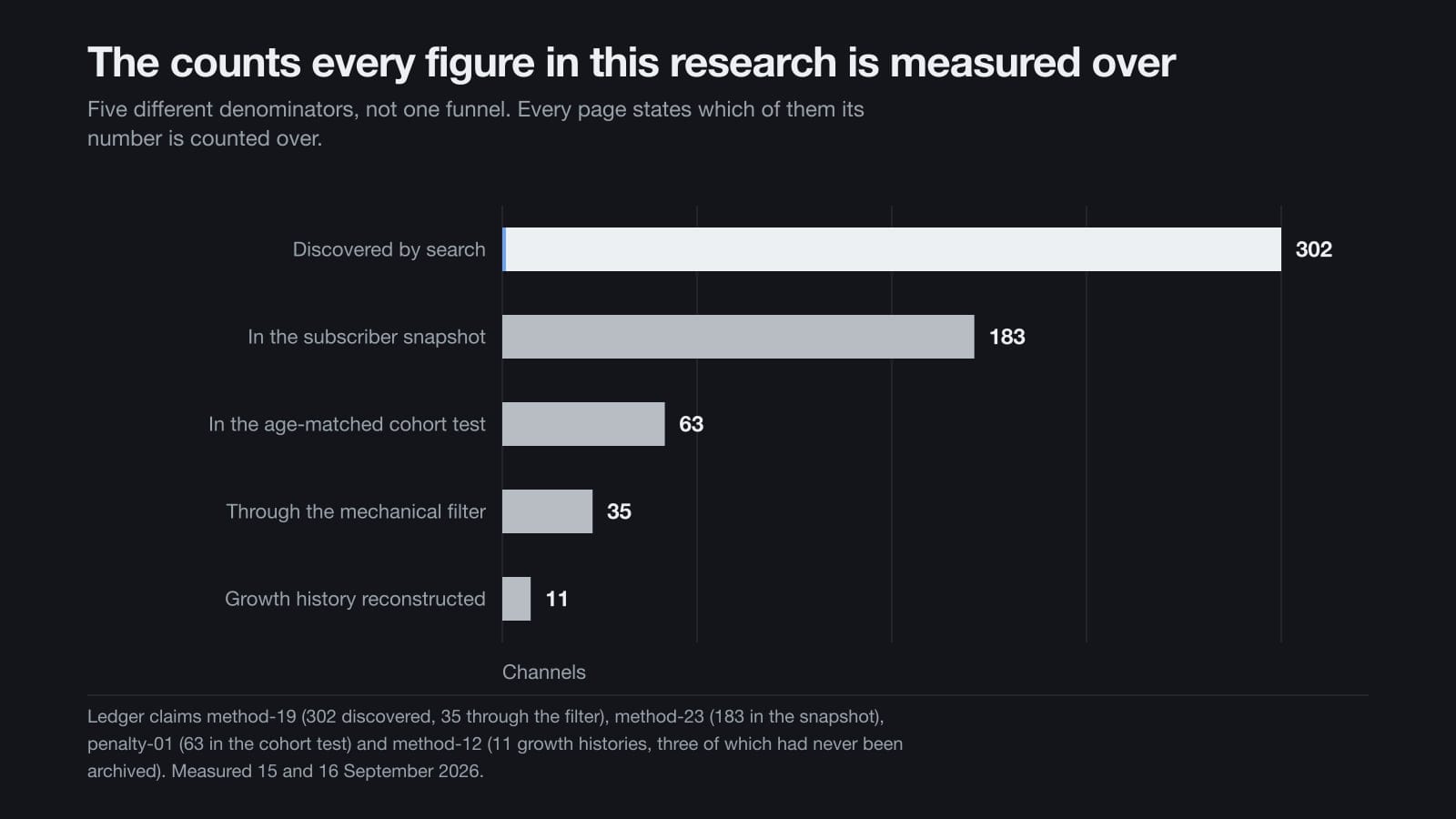
The sweep ran 36 search.list calls against the YouTube Data API, three content phrasings for each of twelve content classes. That returned 302 unique channels. A mechanical filter — 40 or more uploads, 5,000 or more subscribers, an age under 60 months — left 35 candidates.
Each of those was taken apart one upload at a time. Uploads under 28 days old were excluded, because they have not finished collecting views. Shorts of three minutes or less were counted separately from long form. The outlier multiplier for an upload is its views divided by the median views of its neighbours in the same format bucket: the trailing form, dividing by the previous ten uploads only, is the primary measure, and the centred form is a secondary reading.
What the sweep cannot do matters as much. Three phrasings for a content class is thin: two classes were re-swept with fresh phrasings and both changed their answer, so a class with no qualifying channel is under-sampled rather than empty. Subscriber counts are a single snapshot taken on one day.
Click-through, retention and revenue are not public for any channel launchtube does not own, so no page in this section states them. Several judgements were made from thumbnails and captions rather than from watching a channel end to end, and each page says so where that applies.
Nothing here is a forecast. It is a description of channels that already existed on one day in September 2026, and it cannot tell you what a channel started tomorrow will do. If you want the thing rather than the read-out, the checkout page has the plans and the launch list.
Questions people ask
What did launchtube actually measure?
302 faceless YouTube channels, discovered on 15 September 2026 by 36 search calls against the YouTube Data API across twelve content classes. A mechanical filter of 40 or more uploads, 5,000 or more subscribers and an age under 60 months left 35 candidates, and those were taken apart one upload at a time.
How many pages are in this research, and what does each one answer?
Six. What the fastest-growing channels published, how growth is measured from outside a channel, how long the videos ran, what decides a breakout, whether generated channels are penalised, and which niches held anything at all. The method page is the one to read first if you intend to check the others.
Is every number on these pages traceable?
Yes. Every figure comes from a numbered claim in launchtube’s own claim ledger, carrying its value, its n, the date it was measured and the limits on it. A number that could not be traced to a file was removed rather than softened, and the pages say where that happened.
Does this research state earnings, click-through or retention?
No, and it never collected them. None of those figures is public for a channel launchtube does not own. The public most-replayed heatmap is the ceiling of what can be seen from outside, and it is a replay shape rather than retention.
Can a class with no qualifying channel be called an empty niche?
No. Three search phrasings per class is a thin net: two of the twelve classes were re-swept with fresh phrasings and both changed their answer. A class with nothing in it is reported as none found in this sample, never as none exist.
Does any of this forecast what a new channel will do?
No. It describes channels that already existed on 15 and 16 September 2026, measured only on channels that had already grown enough to be found by a search. Nothing here is a prediction of subscribers or views for a channel started tomorrow.