How long a faceless channel's videos are
- Published
- Last updated
- Written by
- launchtube
Two answers came out of this research and they point in opposite directions. Videos of 8 to 12 minutes hold their last quarter better than any other long-form band — their final quarter replays at 0.81 of their first, against 0.52 for videos over 20 minutes, across 81 videos measured on 15 September 2026 — while eight of the ten generated channels found to be at their peak on 16 September 2026 were publishing files of 16 to 151 minutes.
Four to twelve minutes is therefore written up here as a cold-start hypothesis to be tested on a new channel's first five uploads, not as a proven rule.
What the replay shape does by length band
Take every long-form video in the shortlist with a usable public replay curve, split it into quarters, and compare the last quarter with the first. The pattern is monotonic: the longer the file, the worse it holds its back end. The ratio runs 0.81 at 8 to 12 minutes, 0.69 at 12 to 20, and 0.52 at 20 and over, across 81 videos measured on 15 September 2026.
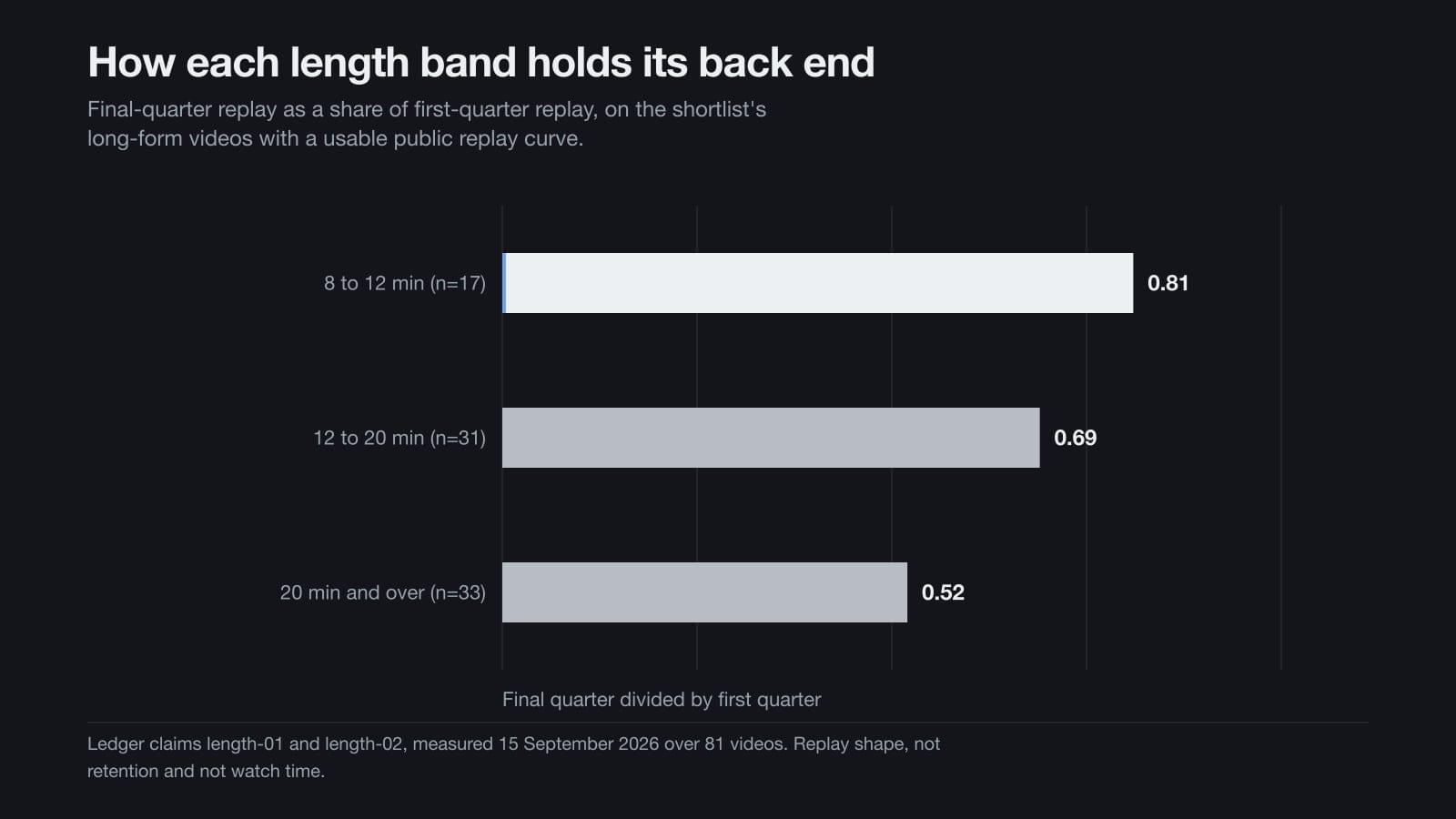
| Band | Final quarter ÷ first quarter | Videos (n) | Best videos in the band |
|---|---|---|---|
| 8 to 12 minutes | 0.81 | 17 | 1.04, flat to the end (n=9) |
| 12 to 20 minutes | 0.69 | 31 | Not measured separately |
| 20 minutes and over | 0.52 | 33 | 0.57 (n=31) |
The top of the 8 to 12 minute band is the striking part. The best-performing videos in it are flat to the end, with a final quarter at 1.04 of their first, against 0.57 for the best videos over 20 minutes. That is nine videos, indicative of the top of the band rather than of the band as a whole.
What the back-end hold is, and what it is not
This is replay shape, not audience retention and not watch time. It shows which parts of a video get replayed relative to the rest of that same video, and no more. A longer video that loses more of its back end can still deliver more total minutes watched, and nothing in this measure can show otherwise.
That limit is not a caveat bolted on at the end; it is the ceiling on what anyone can measure from outside a channel. Why the public replay curve is a replay shape rather than retention, and what else the sweep could and could not see, is set out in full on how channel growth is measured.
Young channels and the 8 to 12 minute band
On young channels the band is the best performer by a wide margin. One channel's 2026 uploads scored 3.24 on the trailing multiplier at 8 to 12 minutes against 0.49 at 12 to 20. A second young channel showed the same shape, scoring 2.60 in the 8 to 12 minute band in 2026.
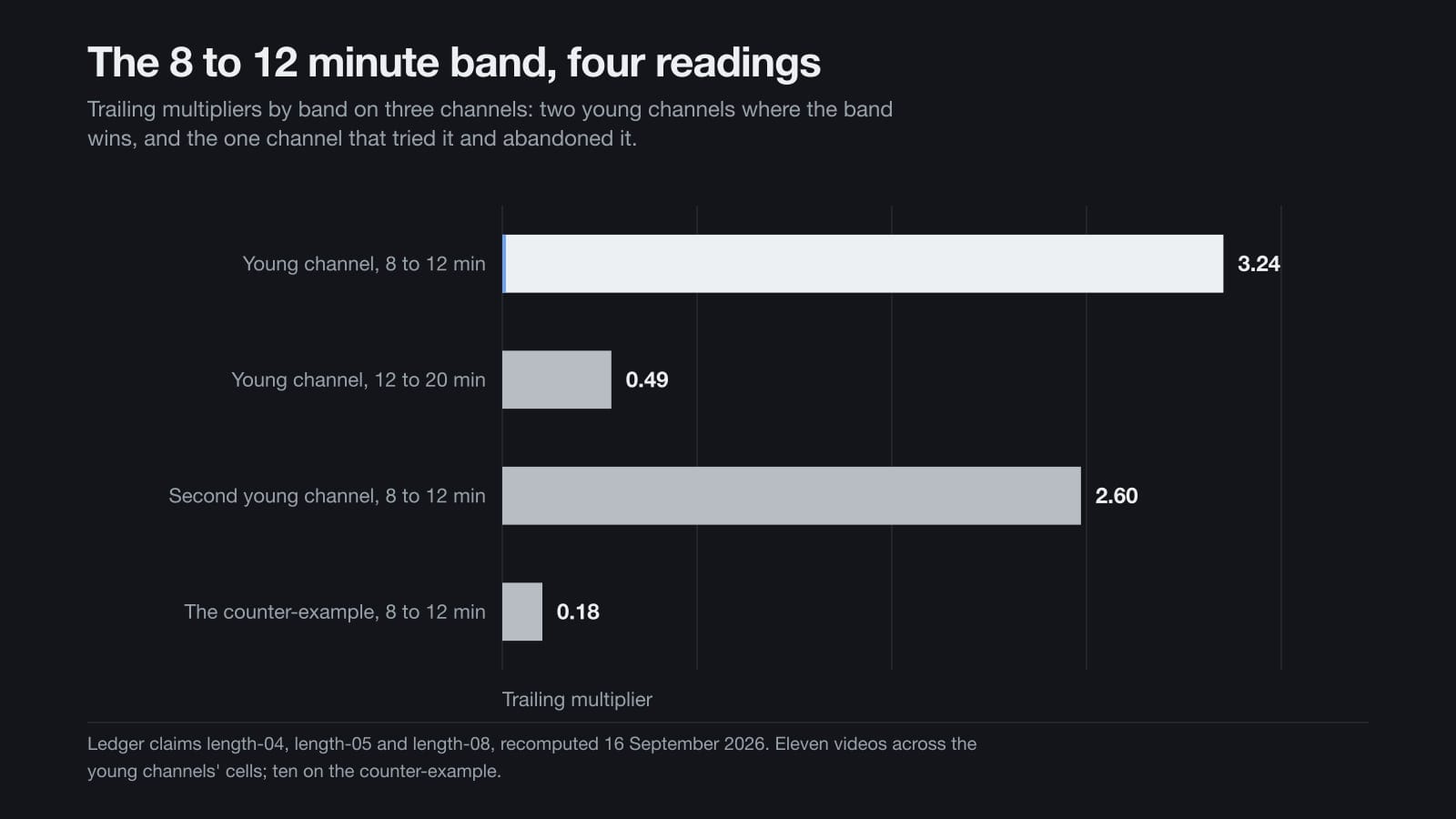
Both figures are thin. The first rests on two young channels with eleven videos between them in the 8 to 12 minute cells, and the report that produced it calls the finding directional rather than a rule; the centred version of the same figure is 2.72 to 2.73. The second is five videos, which is the floor below which this research refuses to call anything a verdict. They corroborate each other and neither settles the question.
Mature channels and files over 20 minutes
On mature million-subscriber channels the picture reverses, and videos over 20 minutes win every year. That is the finding as the first pass recorded it, and it is the one that weakened most under review.
On the largest channel in the set the verdict did not survive re-normalisation: on the trailing multiplier its 8 to 12 minute band became its best, at 1.39. It survives on one other channel, in 2024 only. The honest summary is that mature channels want long videos is weakly supported. The arithmetic behind that reversal — a centred window looks ten uploads into the future and scores a channel's early, shorter videos against a channel they helped build — is on the method page.
The counter-example
One channel in the research argues directly against the band, and it is the strongest single piece of evidence there is against short files. EpicAIFilms, measured 16 September 2026, tried 8 to 12 minute videos and scored 0.18 in that band against 1.48 and 1.25 in its longer bands, abandoned the band entirely the following year, and now runs 20 to 80 minute films.
The numbers behind it are ten videos at 8 to 12 minutes in 2025, at a median of 13,000 views, against eleven at 12 to 20 and sixteen at 20 and over. It is one channel in one genre. It is also the fastest-growing generated channel found anywhere in the research, which is why it is quoted here rather than set aside.
What the channels at their peak were actually publishing
The cohort test asked which generated channels were still rising on the day of measurement, and the answer does not favour short files. Of the ten found to be at their peak, eight were publishing videos of 16 to 151 minutes and six were over 100 minutes. That is the strongest evidence in the research that long files, not short ones, are what was growing in 2026.
Only two of those ten were publishing near the 8 to 12 minute band, at medians of 16.9 and 9.0 minutes. One of the two reached that band through a format change in late 2025 rather than a trend, which makes it a thin base for the short-form case.
The ledger also records a disagreement between two reports over the runtime of one of them; both readings put it above the 8 to 12 minute band, and its share of Shorts is not stated here because the sources contradict each other.
Where the 8 to 12 minute band does appear
The band is not confined to small channels. An illustrated listicle channel with nearly two million subscribers runs an 11.6 minute median across 166 uploads, which is the clearest evidence that 8 to 12 minutes scales to seven figures; its recent window was declining at the time of measurement, at a median multiplier of 0.64 over nine videos. A narrated generated space-documentary channel sits exactly in the band, at an 11.4 minute median across the clean 82 per cent of its uploads.
| Channel or field | Median runtime | n | What it shows |
|---|---|---|---|
| The Paint Explainer, illustrated listicles | 11.6 minutes | 166 uploads | The band reaches seven figures; not that it is the reason |
| ActualSpace, narrated space documentary | 11.4 minutes | 64 videos in the clean subset | A generated channel sitting in the band |
| Storybook folklore breakouts | 7 to 10 minutes | 2 channels | Two-million-view breakouts in the band, both channels dormant by the measurement date |
| Compliance-explainer field, winning long videos | 6 to 13 minutes | One presenter-led catalogue | Long form beating Shorts, 1,290 median views to 230 |
| Leading channels in the AI-automation field | 16 to 27 minutes | 200 videos, four channels | 96 per cent long form; only 30 of 192 long videos in the band |
Two of those rows carry their own warning. The storybook folklore channels were dormant at the time of measurement, at 184 and 654 days without an upload, which makes them historical proof rather than a live signal. And the compliance-explainer figure was measured on a presenter-led channel; whether it transfers to a generated one is untested. In the AI-automation field the band works but is not where the volume is: the best-performing 8 to 12 minute videos there took 113,000 to 301,000 views.
Where length is the product rather than a choice
One segment breaks the pattern completely. In sleep content, performance is flat from 20 to 180 minutes and only lifts above 180, where the winning products are compilations and public-domain readings. Band medians run 0.75, 0.98, 0.71, 0.89, 0.99 and 1.13 from 20 minutes to 180-plus, across 2,788 mature videos, and the further lift above 360 minutes is a duration-as-product effect rather than a quality one.
The same segment shows what happens when a long-form framing is applied to a short file. Sleep-framed videos of 4 to 20 minutes had a median of 1,546 views against 7,547 for the same subjects unframed.
The n is 33 sleep-framed against 21 unframed, and the unframed pull is a ceiling sample of the top 25 by views rather than typical videos, so the size of the gap is overstated. The direction is the useful part: the subjects travel and the sleep framing does not. Which subjects travel at all is the subject of the page on niches.
Four to twelve minutes as a cold-start hypothesis
Put the two halves together and the most likely reading — an interpretation of two patterns, not a measurement — is that 20-plus minutes is what an established audience will sit through, and 8 to 12 minutes is what wins a cold one. No experiment in this research separated audience maturity from the other differences between those channels, so that reading is inferred rather than shown.
The research's own conclusion is stated at the same strength, and it is also an inference rather than a measurement: four to twelve minutes is a cold-start hypothesis to be tested on a new channel's first five uploads, not a proven rule.
It is the weakest link in the work, and anyone quoting the 8 to 12 minute finding is expected to quote this alongside it. Nothing here forecasts what a channel started tomorrow will do; what the first five uploads are actually deciding is set out in breakout before the click, and the rest of the measurements sit in the research section.
How this was measured
Discovery ran on 15 September 2026: 36 search.list calls against the YouTube Data API, three content phrasings for each of twelve content classes. That returned 302 unique channels. A mechanical filter — 40 or more uploads, 5,000 or more subscribers, under 60 months old — left 35 candidates.
Each candidate was taken apart upload by upload. Uploads under 28 days old were excluded, because they have not finished collecting views. Shorts of three minutes or less were counted separately from long form. The outlier multiplier for an upload is its views divided by the median views of its neighbours in the same format bucket, which measures a video against its own channel rather than against YouTube. The trailing form, which divides by the previous ten uploads only, is the primary measure, because it divides by uploads that already existed when the video was published; the centred form, which divides by the ten before and the ten after, is a secondary reading and is biased against early uploads.
Three phrasings per class is thin. Two classes were re-swept with fresh phrasings and both changed their answer, so a class with no qualifying channel is under-sampled rather than empty. Subscriber counts are a single snapshot. Click-through, retention and revenue are not public for any channel launchtube does not own, so no figure on this page states them.
The back-end hold on this page is the last quarter of a video’s public replay curve divided by its first quarter, measured on the shortlist’s long-form videos that had a usable curve: 17 videos at 8 to 12 minutes, 31 at 12 to 20 and 33 at 20 and over, on 15 September 2026. Length-band multipliers are trailing multipliers, computed within a channel-year, and recomputed on 16 September 2026.
What the page cannot show. Replay shape is not retention and not watch time, and it cannot prove that a shorter file delivers more total minutes watched. The young-channel figures rest on eleven videos across two channels and five on a third, which the source reports call directional. The counter-example is one channel in one genre. The peaking-channel counts are ten channels. No figure here is a forecast, and the research’s own conclusion is that four to twelve minutes is a hypothesis to be tested on a new channel’s first five uploads.
Questions people ask
How long should a faceless channel’s videos be?
The research does not answer that, and says so. Four to twelve minutes is a cold-start hypothesis to be tested on a new channel’s first five uploads, not a proven rule. Eight of the ten generated channels found to be at their peak on 16 September 2026 were publishing files of 16 to 151 minutes, which is the strongest evidence against the short answer.
Which length band holds its back end best?
Videos of 8 to 12 minutes. Their final quarter replays at 0.81 of their first, against 0.69 at 12 to 20 minutes and 0.52 over 20 minutes, across 81 videos measured on 15 September 2026. The pattern is monotonic: the longer the file, the worse it holds its back end.
Does a better back-end hold mean more watch time?
No. This is replay shape, not retention and not watch time. It shows which parts of a video are replayed relative to the rest of that same video, and a longer video that loses more of its back end can still deliver more total minutes watched.
Why do young and mature channels give different answers?
On young channels the 8 to 12 minute band wins by a wide margin, at 3.24 on the trailing multiplier against 0.49 at 12 to 20 on one channel and 2.60 on a second. On mature channels the first pass found videos over 20 minutes winning every year, but that verdict did not survive re-normalisation on the largest channel in the set, whose 8 to 12 minute band became its best at 1.39. The most likely reading, which is an interpretation rather than a measurement, is that 20-plus minutes is what an established audience will sit through and 8 to 12 minutes is what wins a cold one.
Is there a case against short videos in this research?
Yes, and it is the strongest single piece of evidence in the file. One fast-growing generated channel tried 8 to 12 minute videos, scored 0.18 in that band against 1.48 and 1.25 in its longer bands over ten videos at a median of 13,000 views, abandoned the band the following year, and now runs 20 to 80 minute films.
Does the 8 to 12 minute band work at scale?
It reaches that scale. An illustrated listicle channel with nearly two million subscribers runs an 11.6 minute median across 166 uploads, and a narrated generated space-documentary channel sits at an 11.4 minute median across 64 clean uploads. Neither shows that the runtime is the reason.
Sources and further reading
What this page is built from
- 17a — proof-channel sweep read-out — 302 channels discovered, 35 through the filter, 12 content classes
- 17 — proof channels plan, §4.1 qualification rules — the rules a channel had to meet to be torn down
- Backtrack report §3, by length band — the replay curve split into quarters — 81 long-form videos with a usable curve: 17, 31 and 33 by band
- Re-normalisation review, objection 4 — length band by channel-year on the trailing multiplier — two young channels, 11 videos across the 8 to 12 minute cells
- Decay check on the one accelerating generated channel — length by year — 10 videos at 8 to 12 minutes in 2025, 11 at 12 to 20, 16 at 20 and over
- Age-matched cohort test §3 — what the channels at their peak were publishing — 10 channels at their peak, 8 of them at 16 to 151 minutes
- Sleep-duration class report — performance by duration band — 2,788 mature videos; 33 sleep-framed against 21 unframed at 4 to 20 minutes
- Format-first and space re-sweeps — median runtimes outside the shortlist — 166 uploads on one channel, 64 clean uploads on another
- Model set for the AI-automation field — title patterns and runtime — 200 videos from the four largest channels in the field
- Model set for the regulatory compliance-explainer field — 69 channels; one presenter-led catalogue measured in full
The authorities this page draws on
- Top ways to ensure your content performs well in Google's AI experiences Google Search Central, last updated
- Disclosing use of GenAI content YouTube Help
- YouTube Partner Program overview & eligibility YouTube Help
- Wayback Machine, used to date a channel’s earlier titles and descriptions Internet Archive
- Use chapters, mentioned people and places, & seeking features — the most replayed graph the length bands are read from YouTube Help
- Videos: list — where a video’s duration and view count are read Google for Developers
About this research
launchtube runs and publishes this research itself. It is one company's measurements of public YouTube channels, taken on a stated date with a stated method, and it is written by launchtube rather than by any named individual. Where a number cannot be traced to a file it is removed, not softened, and where the data cannot answer a question the page says so.
Every research page, and what launchtube does with it.
Add launchtube as a preferred source in Google