Faceless channel niches in 2026
- Published
- Last updated
- Written by
- launchtube
Twelve content classes were swept on 15 September 2026, and the strongest was prehistoric nature: the largest channel in it held 1.52 million subscribers across 150 uploads with no Shorts at all, and the newest broke out on its second video, two days after launch — a break measured as a multiple of that channel’s own baseline, not as a first video past a fixed view threshold. Two fields came back the other way. Across 69 channels in regulatory-compliance explainers and 74 in AI automation, not one faceless generated channel exists.
The twelve classes, and what each returned
Each class was searched with three content phrasings against the YouTube Data API. The table is the read-out class by class: what was measured inside it, what it is counted over, and the part that matters most — what the figure does not show. Every multiplier is a video’s views against its own channel’s rolling median.
| Content class | What was measured | Counted over | Measured | Headline figure | What it shows, and does not |
|---|---|---|---|---|---|
| Prehistoric nature | ExtinctZoo at 1.52 million subscribers across 150 uploads and no Shorts; Deep Sea Relics broke out on its second video, two days after launch, measured as a multiple of its own baseline rather than against a view threshold | 2 qualifying channels | 15 Sep 2026 | 1.44× best cluster | The strongest class in the sweep. The larger channel was 51 months old, past its peak, and its public catalogue was truncated, so it cannot evidence a cold start. |
| Sleep science facts | Five channels, every one with zero Shorts across 318, 281, 124, 237 and 171 uploads, at median runtimes of 100 to 145 minutes and about 22 uploads a month | 5 channels | 15 Sep 2026 | 100,000 subscribers in 3.3 months | The fastest dated cold start in the research, reconstructed from eleven archived snapshots with interpolated milestone dates. That channel was down 74 per cent from its peak when it was measured. |
| Sleep by duration | Which subjects won inside the sleep segment: space and astronomy first, prehistoric earth second, not sleep itself | 65 videos, and 76 and 19 on two others | 15 Sep 2026 | 2.09× space and astronomy | Rising to 3.31 over the previous 60 days on one channel; physics and maths lost, below 0.7. Whether those subjects travel to short videos is inferred from adjacent results, not from a matched test. |
| Animated science explainer | A widened re-sweep of 122 channels produced no new qualifying channel, leaving the class resting on a single model | 122 channels | 15 Sep 2026 | 0 new qualifiers | A negative from one night’s searching in one language. The nearest structural match was under the upload floor and inactive. |
| Odd history | Swept as one of the twelve classes | Part of the 302 channels discovered | 15 Sep 2026 | No separate verdict | The claim ledger carries no separate finding for this class, so none is stated here. |
| Mythology | Pantheon Mythology at 297,000 subscribers, posting both Shorts and long form, on a 16.9 minute median, and at its peak when it was measured | 1 channel at peak | 16 Sep 2026 | Quarterly median 70,000 to 81,000 | Its winning length sits above the eight-to-twelve-minute band, and a separate report measures the same channel at a 19.5 minute median. |
| Mystery and folklore | Naming a specific folklore entity in the title against generic horror titling on the same channel | 64 named against 67 generic; 20 against 72 on a second channel | 15 Sep 2026 | 1.36× named, 0.78× generic | Both channels were dormant when measured, and the premium had decayed to 0.91 by 2025. |
| History as documentary | Seven candidate channels inspected; the supply is real footage, costumed reenactment and on-camera hosts | 7 channels | 15 Sep 2026 | 0 qualifiers of 7 | The clearest demonstration in the sweep that a zero reflects the search rather than the field: the class reopened under a different search as cinematic reconstruction. |
| Geography and space | ActualSpace at 54,100 subscribers on an 11.4 minute median across the 82 per cent of its catalogue that is clean; geography returned nothing across two sweeps | 64 clean videos on 1 channel | 15 Sep 2026 | 0 generated geography channels | The channels that grow in geography use real satellite imagery with the story burned into the frame, several with no spoken narration at all. Confirmed twice, so it is one of the better-sampled negatives. |
| Hobby how-to | Content pulls to diagrams, whiteboards, screen capture and workshop footage | Part of about 720 channels across two classes | 15 Sep 2026 | 0 qualifiers | Well sampled by the study’s own standard, but only two narrative-worded searches were run per class, so the narrative angle is not exhaustively closed. |
| Product-agnostic tech explainer | The same pull to screen capture and factory footage | Part of the same 720 channels | 15 Sep 2026 | 0 qualifiers | A dead end for a rendered channel on this evidence, on the same two-search caution. |
| Evergreen lists | Two channels torn down of 138 found, the larger at 1.39 million subscribers, with breakout clusters running 3.6 to 17.7 times baseline | 2 channels of 138 | 15 Sep 2026 | 1.39 million subscribers | The format reaches seven figures, but on both channels the growth sits in subject matter a generated channel cannot take on. Both also run well above the eight-to-twelve-minute band, at 23 and 15 minute medians. |
Two of these twelve classes were re-swept with fresh phrasings and both changed their answer, which is why a nil return above is written as a thin search rather than a verdict. The measures themselves, and what each one misses, are set out in how growth was measured.
Prehistoric nature, the strongest class
The class produced two qualifying channels. The one with a catalogue long enough to take apart had its 146 mature long videos reclustered into twelve topic groups on 16 September 2026, which supersedes the first clustering: the original had no cluster column on disk and the reclustering is reproducible.
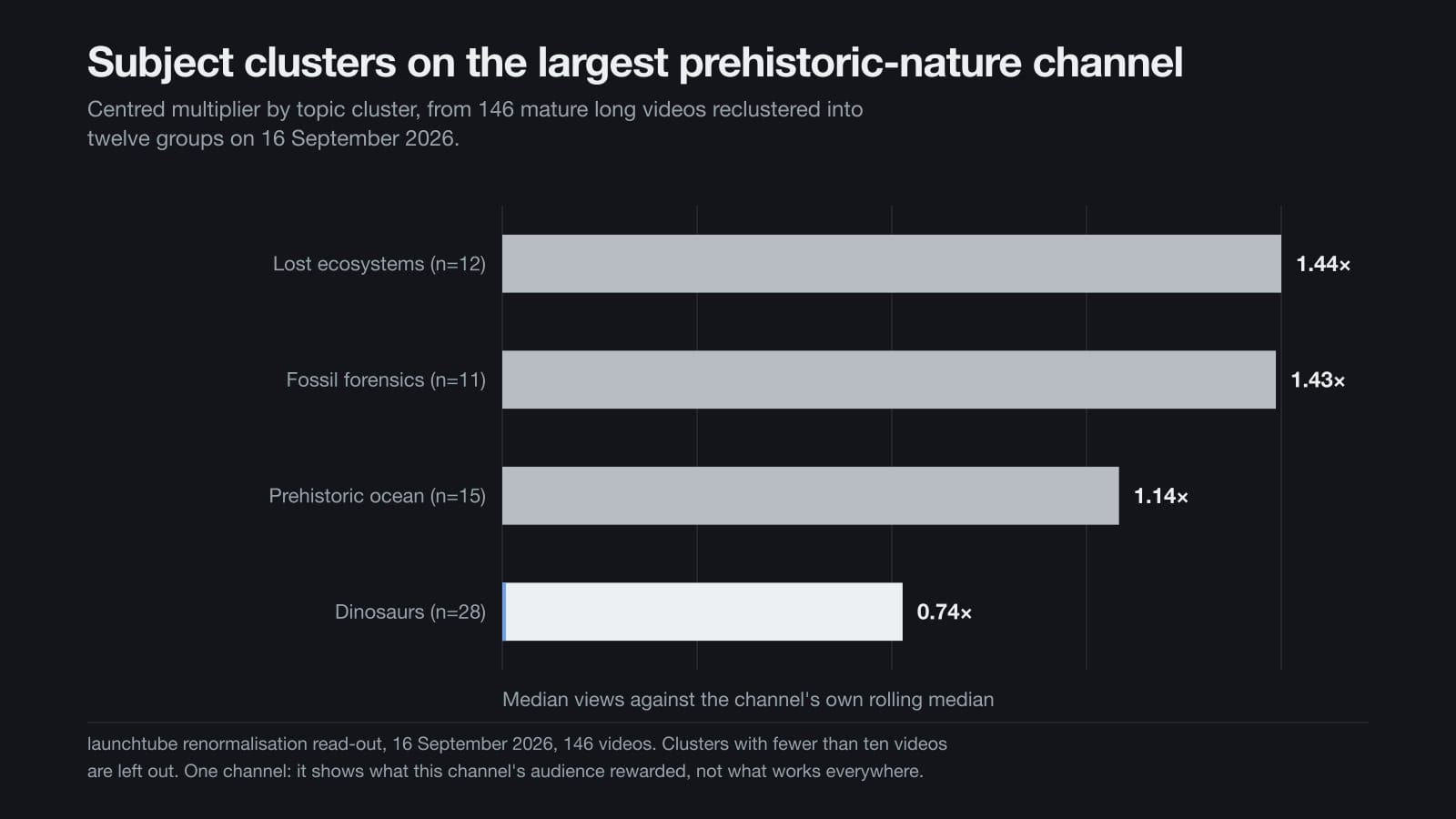
| Cluster | Videos | Centred multiplier | What it shows, and does not |
|---|---|---|---|
| Place-and-period lost ecosystems | 12 | 1.44× | The best cluster of the twelve, with a 17 per cent breakout rate. |
| Fossil-forensics reveals | 11 | 1.43× | 1.62 on the trailing measure, and rising across the channel’s three eras from 0.53 to 1.43 to 2.28. The eras are simply thirds of the catalogue. |
| Prehistoric ocean | 15 | 1.14× | The highest breakout rate of any cluster of ten or more, at 20 per cent, on a middling median. A typical video is ordinary and the exceptional ones are large, which is a different bet from a reliably above-average cluster. |
| Dinosaurs | 28 | 0.74× | The most-produced subject on the channel and its worst large cluster, with zero breakouts in any of the three eras. One channel: it shows this audience did not reward dinosaurs, not that dinosaurs fail everywhere. |
The clusters are a hand-tuned lexicon, with eight to twelve of the 146 titles debatable. The judgement the research attaches to the class is an inference rather than a measurement: extinct subjects are the most renderable content found in the whole sweep, because there is nothing real to photograph, so there is no real-footage competitor and no real-person risk.
Era-and-place reconstruction, a format rather than a niche
A genre of photoreal historical reconstruction emerged across 2025 and 2026 that no subject-based search surfaced. It was found by searching for the look instead, across 337 unique channels: three channels launched within the previous 5 to 14 months, all narrated, all built on generic roles rather than named people, at 45,300, 54,900 and 20,500 subscribers.
All three were past their peak when they were measured, down 90, 82 and 91 per cent, on small per-channel cohorts of 6, 19 and 2 videos. That makes the genre a format to borrow rather than a growing niche to enter; it does not show the format cannot work for a new entrant.
Inside it, two things held up while the channels around them declined: a royalty cluster at 4.51 across seven videos, and a serialised “day in the life” format that was stable at 0.97 — stable, but merely average. A pirates cluster at 10.05 sat on four videos, below the reporting floor. The titles that produced those breakouts are broken down in breakout before the click.
The fastest-growing generated channel found anywhere in the research is adjacent to this genre: cinematic fantasy at 20 to 80 minutes, EpicAIFilms, measured 16 September 2026, taking a median of 181,802 views per long video and about 7,468 subscribers a month across 74 videos in 24 months.
Its first long video took 155,000 views in 24 days, so it does restart from a standing start. Against that, 58 per cent of its top videos lean on third-party fantasy material and only about 17 per cent of its beats would survive a one-character-per-shot rule.
Painterly mythology, and a format that exhausted itself
Mythology produced the one painterly channel in the sweep that was at its peak when it was measured: 297,000 subscribers on 16 September 2026, posting both Shorts and long form, on a 16.9 minute median, with its quarterly median rising from 70,000 to 81,000. The sources disagree on its exact runtime, and the page quotes the figure with that caveat rather than averaging them.
The encyclopedic format that class is known for did not last. Lineups of the “every god of X” kind decayed from 37 times baseline to 0.2 across nine time-ordered videos between December 2023 and October 2024 — about ten months — after which the channel went dormant. Whether that was saturation or the creator losing interest cannot be separated from nine videos on one channel.
Two smaller findings sit beside it. Explicit multi-part serialisation decayed with every episode in the one case measured, from 1.65 on part one to 0.19, 0.17, 0.14 and 0.19, and was never repeated by that creator; at five videos it is below the verdict floor, and a recurring cast across separate videos did hold up on the same channel.
And the single largest outlier measured anywhere in the sweep was a mythology video at 147.76 times its channel’s baseline — 264,925 views against a norm of one or two thousand — on a channel that holds 59.7 per cent of its lifetime views in that one video.
The folklore premium that made named entities worth titling has already gone. On the channel with the longest record it fell from 4.55 in 2021 to 0.91 in 2025, ten videos in each year, on a channel that had been dormant for months when it was read.
How much of these two formats could actually be produced without on-screen text or crowd scenes was estimated from thumbnails alone, and the research tags the estimate as speculative: roughly 70 to 80 per cent for one and 30 to 40 per cent for the other, never frame-checked against the videos.
Sleep science, where the winning file is two hours long
The sleep segment is the clearest inversion of everything a short-video strategy assumes. The winning format is a two-hour video with no Shorts at all, published around 22 times a month, measured across five channels with zero Shorts between them over 318, 281, 124, 237 and 171 uploads, at median runtimes of 100 to 145 minutes.
It also holds the fastest dated cold start in the research, read on 15 September 2026: Sleepy Science Channel went from 53 subscribers on day 17 to 100,000 in 3.3 months, reconstructed from eleven archived snapshots with the milestone dates interpolated between them. By the time it was measured that channel was down 74 per cent from its peak.
The subjects that won inside the segment were not sleep. Space and astronomy came first at 2.09 across 65 videos, rising to 3.31 over the previous 60 days on one channel and 1.20 across 76 on another, with prehistoric earth second at 1.35 across 19. Physics and maths lost, below 0.7. What those runtimes mean for a channel’s month is the subject of the page on video length.
Space as a subject, not as a class
Space travels well inside other classes and badly as a class of its own. No generated space channel qualified in the sweep. The one narrated cinematic space documentary found, ActualSpace at 54,100 subscribers on 15 September 2026, sits at an 11.4 minute median across the 64 videos that make up the clean 82 per cent of its catalogue.
The other 18 per cent used real people’s photographs in fake-news framing, and that subset underperformed the clean one, at 4,934 median views against 6,700 — so the rule-breaking was not the growth driver. Geography returned zero qualifying channels across two separate sweeps; the channels that grow there run real satellite imagery with the story burned into the frame, and several have no spoken narration at all.
The classes that returned nothing, and what that is worth
About 720 channels across the two instructional classes returned zero qualifiers, because the content pulls to diagrams, whiteboards, screen capture and factory footage. History as documentary returned zero of seven candidates. A widened re-sweep of 122 channels in animated science produced no new qualifier at all.
None of those is proof that the field is empty. Three phrasings per class is a thin net; two classes were re-swept and both changed their answer, and the history class reopened entirely when the search was run by look rather than by subject. A cluster of fewer than five videos is never treated as a verdict here, and every multiplier carries its n.
Two findings from those classes are worth keeping. The evergreen-listicle format reaches seven figures — 1.39 million subscribers on the larger of two channels torn down out of 138 found — but on both, the growth sits in subject matter that is off-limits for a generated channel, and both run at 23 and 15 minute medians.
And a flat illustrated listicle channel, The Paint Explainer, read on 15 September 2026, shows the storybook look scaling to 1.99 million subscribers across mystery, history, mythology and space over 166 uploads in 37.9 months, though it was declining in its recent window.
The class that did qualify in animated science carries a warning about public numbers generally. Animated About Chemistry holds 163 subscribers per 1,000 lifetime views, where every other channel measured sits between 3.9 and 22.5 — 244,000 subscribers against 1.49 million lifetime views on 15 September 2026 — and that gap has no public explanation. Deleted high-view uploads or subscribers won elsewhere are inferences, not findings.
The two empty fields
An empty field, in this research, is a niche where channels exist and views exist but no faceless generated channel does. The sweep found two, and this is the one result on the page that comes from counting absences rather than performances.
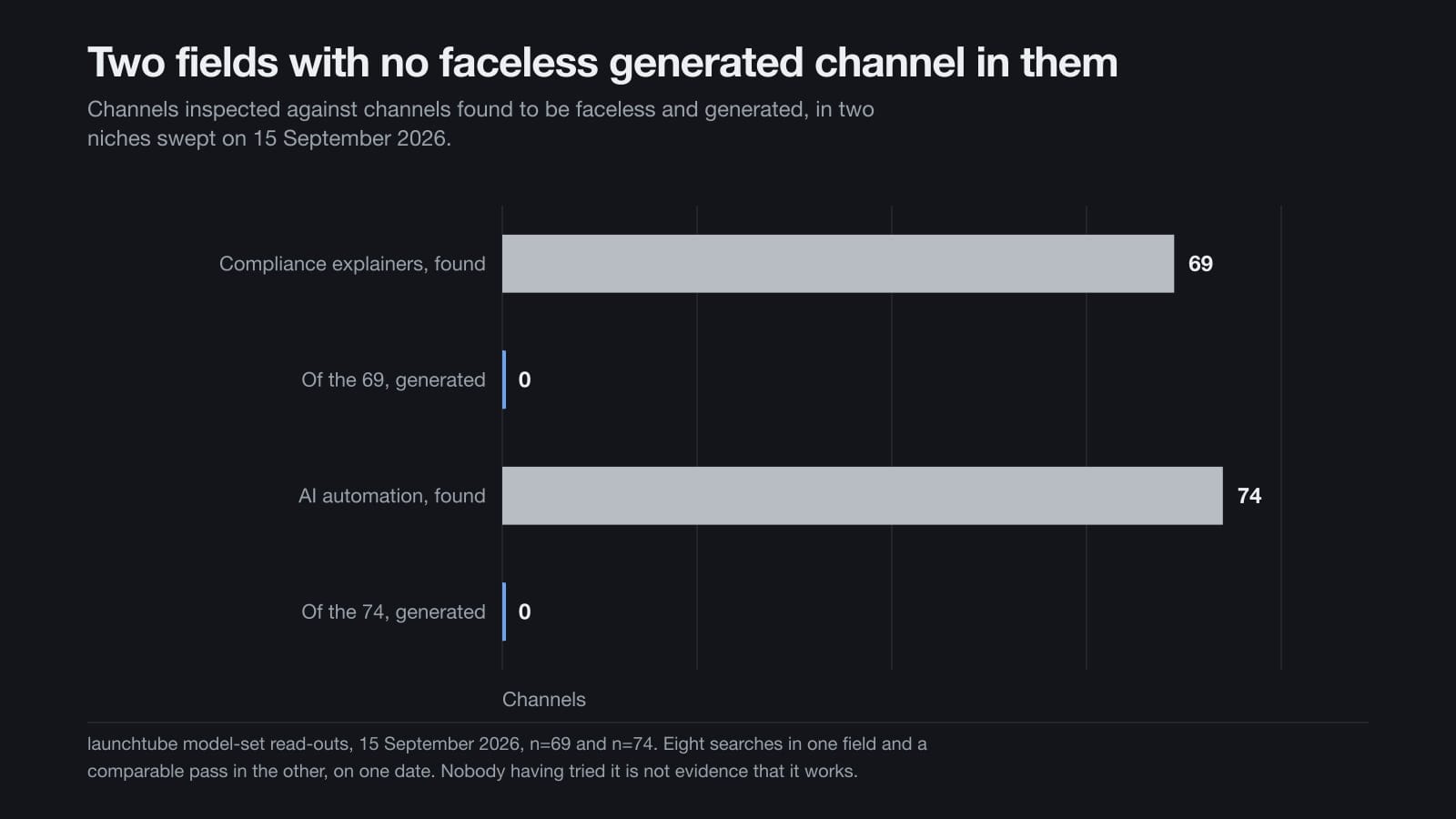
The first is regulatory-compliance explainers. Across 69 channels, every relevant one is presenter-led, from eight searches on a single date. Nobody having tried it is not evidence that it works: the source report’s own warning is that presenter credibility may be the trust signal in that field.
Demand there is real even at small scale. One channel of about 3,600 subscribers takes thousands of views per explainer, and one definitional Short in a non-English language took 1.37 million views against a Shorts median of about 190 on the same kind of channel. Those are outliers, and they show a ceiling rather than a typical outcome.
The second is AI automation. Across 74 channels, not one is faceless and generated, and every channel above about 40,000 subscribers is a named person selling a course or a community. Forty-seven of the 74 failed the 40-upload floor, mostly placeholder channels named after the search string, and two that present as faceless in their names show a human face in their thumbnails.
The catch in that field is renderability. Its winning content is screen-recorded software, which a generated-video pipeline cannot produce, so the lessons it offers are about titles and length rather than format — and that is a judgement from thumbnails and formats, not a performance measurement.
One comparison from the same field is worth stating plainly, because it cuts against the obvious move: a brand-run channel underperformed individual creators covering the same subject by roughly ten to eighteen times. It compares one company channel’s ceiling with single videos from creators in the same niche, on public view counts, so it is two sides of a comparison rather than a controlled test.
What this page does not claim
The transfer of every title lever measured in those two fields is untested, and the research tags it as speculative: all of them were measured on presenter-led channels, and nobody has run them on a faceless generated channel because none exists in either field.
Nor is any of this a forecast. Subscriber-per-month figures are lifetime averages from a single snapshot rather than growth velocity, several qualification judgements were made from thumbnails, descriptions and auto-captions rather than from watching the videos in full.
No figure here states how many people clicked, how long they stayed, or what any channel made. Whether a generated channel is treated differently by the platform is a separate question, answered in does YouTube penalise AI channels, and what the fastest-growing channels were publishing while all this was measured is in what grows a faceless channel. The rest of the research carries the same limits.
How this was measured
Discovery ran on 15 September 2026: 36 search.list calls against the YouTube Data API, three content phrasings for each of twelve content classes. That returned 302 unique channels. A mechanical filter — 40 or more uploads, 5,000 or more subscribers, under 60 months old — left 35 candidates.
Each candidate was taken apart upload by upload. Uploads under 28 days old were excluded, because they have not finished collecting views. Shorts of three minutes or less were counted separately from long form. The outlier multiplier for an upload is its views divided by the median views of its neighbours in the same format bucket, which measures a video against its own channel rather than against YouTube. The trailing form, which divides by the previous ten uploads only, is the primary measure, because it divides by uploads that already existed when the video was published; the centred form, which divides by the ten before and the ten after, is a secondary reading and is biased against early uploads.
Three phrasings per class is thin. Two classes were re-swept with fresh phrasings and both changed their answer, so a class with no qualifying channel is under-sampled rather than empty. Subscriber counts are a single snapshot. Click-through, retention and revenue are not public for any channel launchtube does not own, so no figure on this page states them.
The class verdicts on this page are the per-class reports of 15 September 2026 and the second pass that followed. Two classes were re-swept with fresh phrasings and both changed their answer, and one class that returned nothing under a subject search reopened when the search was run by look instead. Every multiplier carries its n, and a cluster of fewer than five videos is never treated as a verdict.
The subject-cluster figures for the prehistoric-nature channel are the reclustering of 16 September 2026, which supersedes the first pass: the original clustering had no cluster column on disk, the reclustering is reproducible, and the recomputed multipliers reproduce the stored ones to a median absolute difference of 0.003 across 146 videos. Clusters are a hand-tuned lexicon, with 8 to 12 of those 146 titles debatable, and eras are simply thirds of the catalogue.
Questions people ask
Which content class was strongest in the sweep?
Prehistoric nature. The largest channel measured had 1.52 million subscribers across 150 uploads with no Shorts at all, and the newest broke out on its second video, two days after launch. Two channels qualified in the class, both measured on 15 September 2026.
Which subjects worked inside prehistoric nature?
Reclustering 146 mature long videos into twelve groups put place-and-period lost ecosystems at 1.44 and fossil-forensics reveals at 1.43. Prehistoric ocean had the highest breakout rate of any cluster of ten or more videos, at 20 per cent on a middling 1.14, and dinosaurs — the most-produced subject on the channel — were its worst large cluster at 0.74.
What is an empty field in this research?
A niche where channels and views both exist but no faceless generated channel does. Two were found on 15 September 2026: 69 channels inspected in regulatory-compliance explainers and 74 in AI automation, with not one in either field made without a presenter.
Does a class with no qualifying channel mean the niche is empty?
No. Three phrasings per class is a thin net. Two of the twelve classes were re-swept with fresh phrasings and both changed their answer, and the class that returned nothing as history documentary reopened as cinematic reconstruction once the search was run by look rather than by subject.
How long are the videos on the sleep channels measured?
About two hours. Five channels were measured, every one of them with zero Shorts across 318, 281, 124, 237 and 171 uploads, at median runtimes of 100 to 145 minutes and around 22 uploads a month. It is the opposite of a short-video channel in every respect.
Why is the every-god-of-X format treated as exhausted?
Because it decayed from 37 times its channel’s baseline to 0.2 across nine time-ordered videos in about ten months, after which the channel went dormant. Whether that was saturation or the creator losing interest cannot be separated from nine videos on one channel.
Sources and further reading
What this page is built from
- 17a — proof-channel sweep read-out — 302 channels discovered, 35 through the filter, 12 content classes
- 17 — proof channels plan, §4.1 qualification rules — the rules a channel had to meet to be torn down
- 17a — per-class sweep reports and video-level CSVs, twelve content classes — 302 channels discovered, 35 through the filter
- 17a — second-pass re-sweep, including the search by look rather than by subject — 337 unique channels across the format-first pass
- 17a — renormalisation read-out: the subject recluster and the cold-start recompute — 146 mature long videos in twelve clusters
- 17a — model-set read-outs for the two fields with no generated channel in them — 69 and 74 channels inspected
The authorities this page draws on
- Top ways to ensure your content performs well in Google's AI experiences Google Search Central, last updated
- Disclosing use of GenAI content YouTube Help
- YouTube Partner Program overview & eligibility YouTube Help
- Wayback Machine, used to date a channel’s earlier titles and descriptions Internet Archive
- Advertiser-friendly content guidelines YouTube Help
- Determining if your content is "made for kids" YouTube Help
About this research
launchtube runs and publishes this research itself. It is one company's measurements of public YouTube channels, taken on a stated date with a stated method, and it is written by launchtube rather than by any named individual. Where a number cannot be traced to a file it is removed, not softened, and where the data cannot answer a question the page says so.
Every research page, and what launchtube does with it.
Add launchtube as a preferred source in Google